
Introduction
President Donald Trump’s executive order to end birthright citizenship has reignited a long-standing debate in the United States. For over 150 years, the 14th Amendment has guaranteed citizenship to anyone born on U.S. soil. But Trump’s proposal to deny citizenship to children born to undocumented migrants or those on temporary visas has triggered legal challenges and public outcry. In this blog, we explore how birthright citizenship policies compare around the world.
Understanding Jus Soli vs Jus Sanguinis
Globally, countries follow one of two main principles for granting citizenship:

- Jus Soli (Right of the Soil): Citizenship granted by birthplace.
- Jus Sanguinis (Right of Blood): Citizenship granted by parentage.
The U.S. is among roughly 30 countries—mainly in the Americas—that grant unconditional jus soli. In contrast, most European, Asian, and African countries rely on jus sanguinis, sometimes with added conditions.
Top 10 Countries and Their Birthright Citizenship Policies
- United States – Offers unrestricted jus soli under the 14th Amendment. Trump’s 2025 executive order to end this policy is currently under Supreme Court review.
- Canada – Continues to provide automatic birthright citizenship. However, debates around “birth tourism” are ongoing.
- India – Once offered unrestricted jus soli. Since 2004, citizenship is only granted if one parent is Indian and the other is not an illegal migrant.
- Ireland – Ended automatic birthright citizenship in 2004 via referendum. Now requires at least one parent to be a legal resident.
- Dominican Republic – Infamously restricted birthright citizenship in 2013 retroactively to 1929, affecting thousands, mainly of Haitian descent.
- Germany – Follows a modified jus sanguinis system. Children born to foreign parents can acquire citizenship if one parent has lived in Germany for at least eight years.
- Australia – Birthright citizenship is granted only if at least one parent is a citizen or permanent resident.
- France – Grants citizenship to children born in France, but with conditions such as the child residing in France for a period.
- Japan – Strictly adheres to jus sanguinis. Citizenship is determined by Japanese parentage, regardless of birthplace.
- South Africa – Offers a conditional form of jus soli. Citizenship at birth is only granted if at least one parent is a citizen or permanent resident.
Why Countries Are Revising Citizenship Laws
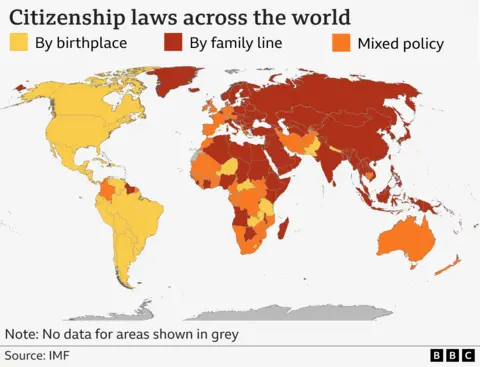
Many nations have tightened their citizenship laws due to concerns about illegal immigration, national identity, and birth tourism. As John Skrentny, a professor at the University of California, notes, birthright citizenship was historically used to include slaves, indigenous populations, and immigrants in post-colonial nation-building. Today, however, easy migration and strategic citizenship-seeking have prompted reevaluations.
Trump’s Executive Order and Legal Hurdles
Trump’s attempt to end birthright citizenship via executive order is already facing legal challenges. Federal courts have blocked the order, citing constitutional protections under the 14th Amendment. While the Supreme Court is set to weigh in, legal experts argue that such a change would require a constitutional amendment—not just executive action.
It is unclear how the Supreme Court, where conservative justices form a supermajority, would interpret the 14th Amendment if it came to it.
Trump’s justice department has argued it only applies to permanent residents. Diplomats, for example, are exempt.
But others counter that other US laws apply to undocumented migrants so the 14th Amendment should too.
Read more about Trump’s 2025 immigration crackdown and its broader implications.
Conclusion
The U.S. is among a shrinking list of countries that offer unconditional birthright citizenship. While Trump’s order has ignited fierce debate, many countries have already moved away from such policies. The legal outcome in the U.S. could have far-reaching consequences—not just for immigrants, but also for the broader understanding of what it means to be a citizen.
Stay informed by subscribing to our newsletter for updates on immigration law and global policy changes.