
Table of Contents
- Background: The Struggle for Donbas
- The Battle for Pokrovsk
- Why Pokrovsk’s Fall Would Matter to Ukraine and Russia
- Geopolitical and Strategic Consequences
- The Human and Psychological Toll
- Conclusion: What Lies Ahead
Background: The Struggle for Donbas
Since the full-scale invasion began in February 2022, eastern Ukraine’s Donbas region—comprising Donetsk and Luhansk—has been at the heart of Russia’s military ambitions. Russian President Vladimir Putin has repeatedly emphasized the “liberation” of Donbas as a central objective of his war, framing it as both a strategic and ideological mission.
For Ukraine, Donbas is more than a battleground. It’s a symbol of national resistance and a vital industrial heartland that once powered the country’s economy. The ongoing war has turned its coal mines, steel plants, and rail hubs into military assets. Among these, Pokrovsk—a modest city before the war—has become a strategic linchpin.
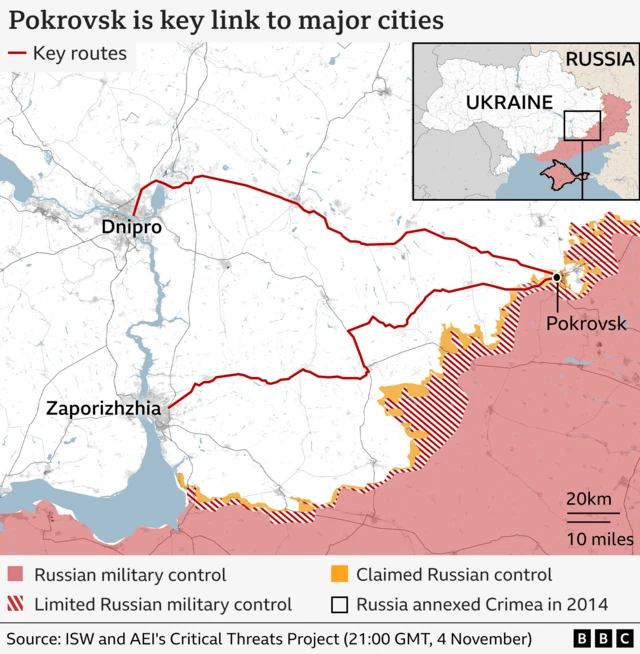
Situated roughly 40 kilometers northwest of Avdiivka, Pokrovsk sits at a key road and rail junction connecting Ukraine’s eastern front to its industrial interior. Before the conflict, its 60,000 residents worked mainly in mining and manufacturing. Now, the town is nearly deserted, scarred by months of airstrikes and shelling, yet crucial to both Kyiv’s defense and Moscow’s ambitions.
The Battle for Pokrovsk
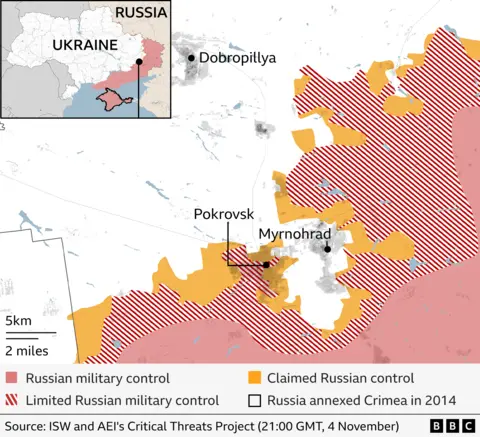
The fight for Pokrovsk has been one of grinding attrition. For more than a year, Ukrainian and Russian forces have clashed in and around the city, with Moscow now claiming to have infiltrated several neighborhoods. Tens of thousands of Russian troops have been redeployed to the area, supported by artillery and drone reconnaissance.
Ukraine’s General Staff continues to deny claims that its forces are encircled, asserting that units are still “actively resisting.” Video footage shared by Ukraine’s elite “Skelya” assault regiment shows troops raising the national flag over the city council building—an emblem of defiance amid uncertainty.
Yet, according to war correspondents and open-source intelligence groups, the situation remains perilous. Ukrainian units are heavily outnumbered, and estimates suggest that over 1,000 soldiers risk encirclement. Russia’s defense ministry insists its troops are “advancing northwards” and creating what it calls “cauldrons”—encircled pockets of Ukrainian resistance. Independent observers, however, caution that much of Pokrovsk remains “no-man’s-land.”
Military analyst Michael Kofman of the Carnegie Endowment for International Peace notes that Russian forces, while slowly advancing, still lack the momentum for a decisive breakthrough. “Infiltration yields a creeping offensive but can’t yield operationally significant breakthroughs,” he wrote, emphasizing that Ukraine retains fallback defensive lines west of the city.
Why Pokrovsk’s Fall Would Matter to Ukraine and Russia
So why does Pokrovsk matter so much? The answer lies in both geography and symbolism.
Strategically, Pokrovsk’s capture would grant Russia a foothold to push deeper into the Donetsk region and potentially advance toward the Dnipropetrovsk and Zaporizhzhia oblasts. The city’s rail and road connections make it a vital logistical artery for Ukrainian troops and supplies. Losing it could disrupt transport lines between the front and Ukraine’s industrial interior.
For Russia, the city represents a symbolic victory—a visible step toward fulfilling Putin’s long-standing goal of “liberating” Donbas. Having already taken Avdiivka in early 2024, Moscow’s forces have spent nearly two years inching toward Pokrovsk. Its capture would allow Putin to claim tangible progress to both domestic and international audiences, bolstering his narrative of steady success despite heavy losses.
Politically, it would also test Kyiv’s resilience and Western support. A Russian victory in Pokrovsk could feed narratives of Ukrainian vulnerability, possibly affecting aid decisions in Washington and European capitals. Analysts suggest that it could even influence diplomatic dynamics, including U.S. President Donald Trump’s renewed efforts to broker a ceasefire—one that might favor Moscow if the battlefield tilts in its favor.
Geopolitical and Strategic Consequences
The implications of Pokrovsk’s fall extend beyond maps and front lines. If Russia secures the city, defending nearby towns like Myrnohrad could become nearly impossible, and Ukrainian forces would likely withdraw westward to strengthen positions along the “fortress belt” cities of Kostyantynivka, Druzhkivka, Kramatorsk, and Slovyansk.
This so-called fortress belt forms the backbone of Ukraine’s defensive network in Donetsk. Each city acts as a bulwark protecting the road to Dnipro and, ultimately, central Ukraine. Should Russia breach this belt, the war could take a far deadlier and more unpredictable turn.
However, as Kofman and other analysts stress, Russia’s ability to exploit a victory remains limited. Its forces are stretched thin, morale is inconsistent, and logistics are strained. Even if Pokrovsk falls, maintaining control over devastated territory will demand enormous manpower and resources. The Institute for the Study of War (ISW) has argued that Moscow “lacks the capacity to rapidly envelop or penetrate the fortress belt,” predicting that any further advances could take years.
Still, time itself is a weapon. Each small gain allows Russia to inch closer to its objective, while Ukraine must defend every kilometer at a cost in men, ammunition, and morale.
The Human and Psychological Toll
Behind the statistics and maps lies an immense human tragedy. Pokrovsk was once a thriving community with schools, cafes, and a rich mining culture. Now, it’s a ghost city. The Ukrainian government began evacuations earlier this year, with remaining residents—mostly elderly and disabled—relying on aid from volunteer units like the White Angel police group.
Satellite images and on-the-ground footage show entire districts reduced to rubble. Civilian casualties are mounting, and humanitarian corridors remain sporadic and dangerous. Russian bombardments have damaged the local hospital, forcing doctors to operate in basements with limited power. Amid this destruction, Ukraine’s police and rescue teams risk their lives daily to extract trapped civilians.
Morale is also at stake. For Ukrainians, Pokrovsk’s defense symbolizes resilience—the will to fight on despite exhaustion. For Russia, the battle is a matter of prestige and proof of progress. The psychological dimension cannot be overstated: whichever flag flies over Pokrovsk will shape perceptions of momentum heading into winter.
As the temperature drops and Russian attacks on Ukraine’s energy grid intensify, losing Pokrovsk could deepen public despair. Power outages, displacement, and battlefield losses would test Kyiv’s ability to maintain unity and Western confidence.
Conclusion: What Lies Ahead
Pokrovsk’s fate remains uncertain. Despite Russia’s incremental advances, Ukrainian resistance persists. Drone footage from recent days shows fierce street-to-street fighting, while Ukrainian artillery continues to strike Russian supply routes.
Even if Pokrovsk falls, it may not alter the war’s overall trajectory immediately. Kyiv retains multiple defensive lines, and Western-supplied long-range weapons continue to disrupt Russian logistics. Yet symbolically, it would mark one of the most painful losses for Ukraine since Avdiivka—and a significant propaganda win for the Kremlin.
As winter approaches, both sides are digging in for a prolonged stalemate. Whether Pokrovsk stands or falls, it encapsulates the larger truth of this war: progress is measured not just in territory, but in endurance, resilience, and the unyielding spirit of a nation fighting for survival.
Related Reads
By The Morning News Informer Editorial Desk — Updated November 8, 2025