
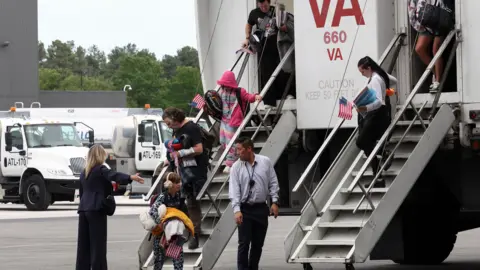
Dulles, Virginia, May 13, 2025 — A group of 59 white South Africans, primarily Afrikaners, arrived in the United States this week under an expedited refugee program announced by President Donald Trump. The move has sparked international controversy, with critics accusing the administration of applying racially biased immigration policies.
President Trump defended the decision, stating the group had faced “racial discrimination” in South Africa. “Farmers are being killed,” Trump said, “they happen to be white, but whether they’re white or black makes no difference to me.” He also referred to a “genocide” taking place in the country—claims that have been widely discredited by independent researchers and South African officials.
Fast-Tracked While Others Wait
What makes this resettlement especially controversial is its speed. Most refugee applicants wait months or years for processing. In contrast, this group was flown in directly to Dulles International Airport, where they were greeted by U.S. officials and supporters holding American flags.
UNHCR, the UN refugee agency, confirmed it was not involved in vetting the Afrikaner group—a rare break from standard protocol. Meanwhile, Trump’s administration continues to pause the U.S. Refugee Admissions Program (USRAP) for refugees from conflict zones, including Syria, Afghanistan, and parts of Africa.
Global Reaction and Criticism
Human Rights Watch slammed the move as a “cruel racial twist.” The Episcopal Church has ended its refugee resettlement cooperation with the U.S. government, citing “preferential treatment.” Prominent critics like Gregory Meeks, a senior Democrat, labeled the policy “a politically motivated rewrite of history.”
South African President Cyril Ramaphosa said the group does not meet the criteria for refugee status. “A refugee must flee due to religious, political, or economic persecution—and this isn’t the case here,” he argued. Ramaphosa also denounced the U.S. interpretation of the situation as “untrue.”
Afrikaners and the Land Reform Debate
The refugee program comes amid tensions over South Africa’s new land reform law, which allows for property seizures without compensation. While the South African government claims no land has yet been seized, Trump and his allies—including South African-born Elon Musk—have criticized the law as discriminatory.
In 2024, police recorded 44 murders on farms and rural lands in South Africa. While no racial breakdown was provided, most farmers in the country are white. Despite this, human rights organizations argue that the violence does not constitute genocide or targeted persecution.
Geopolitical Ramifications
The move has worsened U.S.-South Africa relations. Earlier this year, South Africa’s ambassador was expelled for calling the refugee plan “white victimhood as dog whistle.” In turn, the U.S. accused Pretoria of “race-baiting.” The bilateral fallout comes as the two countries also clash over South Africa’s legal challenge against Israel at the ICJ.
This policy shift further reflects the Trump administration’s broader stance on immigration: welcoming select groups while tightening the doors for others. For more on how Trump’s policies are impacting other regions, see our coverage on U.S.-Canada trade tensions and his recent Gulf investment push.
Conclusion
The arrival of Afrikaner refugees in the U.S. highlights the intersection of race, geopolitics, and immigration policy under President Trump. As criticism mounts from human rights groups, religious institutions, and foreign governments, the administration remains defiant, insisting it is addressing an urgent humanitarian need.