
Introduction
Today, few would imagine that Dubai history, the glimmering jewel of the Middle East, was once administratively tied to British India. But for much of the early 20th century, Dubai and several other Gulf states were governed as extensions of the Indian Empire. In fact, for a brief moment in history, it was entirely possible that Dubai, Bahrain, Kuwait, and Oman might have been integrated into either India or Pakistan after the British Raj’s partition in 1947.
The Forgotten Arabian Raj
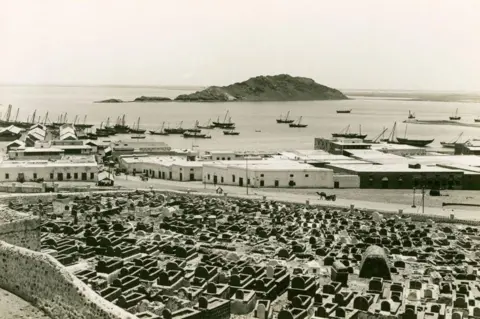
In the early 20th century, a large swathe of the Arabian Peninsula was administered not directly by London but from Delhi, the capital of British India. Territories like Aden, Bahrain, and Dubai were governed under the Indian Political Service, overseen by the Viceroy of India.
By law, under the Interpretation Act of 1889, these protectorates were considered part of British India. Indian passports were issued as far west as Aden (modern-day Yemen), which served as India’s westernmost port, administered as part of Bombay Province. When Mahatma Gandhi visited Aden in 1931, he found many young Arabs identifying with Indian nationalism.
A Secret Administration
Despite their inclusion in the Indian Empire, public maps of the time deliberately omitted these Gulf protectorates to avoid conflict with the Ottoman Empire and later the emerging Saudi state. According to the governor of Aden, the region seemed frozen in time, “as if Victoria was still on the throne.”
British officials described the Gulf as a “phantasmal extension of the Raj.” In Oman, rulers were educated in Rajasthan and spoke fluent Urdu. In Yemen’s Qu’aiti state, soldiers marched in old Hyderabadi army uniforms. These Arab states functioned like the princely states of India, answerable to Delhi, not London.

The Quiet Separation
By the 1920s, as Indian nationalism grew, London began rethinking its administrative structure. In 1937, Aden was officially separated from India and placed under the British Colonial Office. The Gulf protectorates, however, remained under India’s purview until April 1, 1947—just months before India’s independence. British officials debated whether India or Pakistan would take over the Gulf, but ultimately decided to retain direct British control.
Had these minor administrative decisions gone differently, it’s likely the Gulf could have been integrated into India or Pakistan alongside other princely states like Hyderabad and Bahawalpur. [Internal Link: India-Pakistan Partition History]
The Arabian Raj’s Final Days
Even after Indian independence, British India’s legacy in the Gulf lingered for decades. The currency remained the Indian rupee, and many Gulf states were still governed by officials who had made their careers in the Indian Political Service. The British maintained control until their final withdrawal from the Gulf in 1971, just four years before the UAE’s formation.
As David Holden wrote, “This final remnant of the British Raj – for that, in effect, is what it is – has been for some years now an obvious, if in some ways charming, anachronism. But its day is over.”

Erasing History
After independence, the Gulf monarchies successfully rewrote this chapter, emphasizing their sovereignty while quietly erasing the memory of Indian governance. But personal memories remain. As recorded by Gulf scholar Paul Rich, one elderly Qatari recalled being beaten as a child by an Indian employee of the British agent for stealing an orange. He remarked how tables had since turned, with Indians now working as migrants across the Gulf.
Conclusion
Today, millions of South Asians work and live in the Gulf, largely unaware that less than a century ago, places like Dubai could easily have become an extension of modern India or Pakistan. A small administrative shift during the twilight of empire forever altered the geopolitical map of the Middle East. The story remains one of empire’s quietest but most remarkable near misses.
Sam Dalrymple is the author of Shattered Lands: Five Partitions and the Making of Modern Asia.
For more untold histories of India and the Middle East, visit The Morning News Informer.